
Monday, June 18, 2012

Causes of Pleural Effusion


Nursing Care Plan for Pleural Effusion

Pleural Effusion

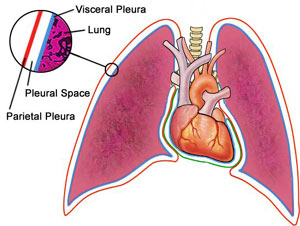
A pleural effusion is an excess accumulation of fluid in the pleural space around the lungs. Medical ImageThe pleura are thin membranes that enclose the lungs and line the inside of the chest cavity. The 'pleural space' describes the small space between the inner and outer layers of pleura, which normally contains a small volume of lubricating pleural fluid to allow the lungs to expand without friction. This fluid is constantly being formed through leakage of fluid from nearby capillaries and then re-absorbed by the body's lymphatic system. With a pleural effusion, some imbalance between production and reabsorption of pleural fluid leads to excess fluid building up in the pleural space. There are two major types of pleural effusion :
  • Transudative effusions, where the excess pleural fluid is low in protein; and
  • Exudative effusions, where the excess pleural fluid is high in protein.

Causes

Anything that causes an imbalance between production and reabsorption of pleural fluid can lead to development of a pleural effusion. Medical Image Transudative pleural effusions (those low in protein) usually form as a result of excess capillary fluid leakage into the pleural space. Common causes of transudative effusions include :
  • Congestive heart failure;
  • Nephrotic syndrome;
  • Cirrhosis of the liver;
  • Pulmonary embolism; and
  • Hypothyroidism.
Exudative effusions, which are high in protein, are often more serious than transudative effusions. They are formed as a result of inflammation of the pleura, which might happen for example in lung disease. Common causes of exudative effusions include :
  • Pneumonia;
  • Lung cancer, or other cancers;
  • Connective tissue diseases, including rheumatoid arthritis and systemic lupus erythematosus;
  • Pulmonary embolism;
  • Asbestosis;
  • Tuberculosis; and
  • Radiotherapy.
Source : virtualmedicalcentre.com

Pleural Effusion Care Plan

Nursing Diagnosis for Pleural Effusion

  1. Ineffective breathing pattern related to decreased lung expansion (accumulation of air / liquid), musculoskeletal disorders, pain / anxiety, the inflammatory process.
  2. Chest pain related to biologic factors (tissue trauma) and physical factors (chest tube installation)


Nursing Intervention for Pleural Effusion
  1. Ineffective breathing pattern related to decreased lung expansion (accumulation of air / liquid), musculoskeletal disorders, pain / anxiety, the inflammatory process.

    Marked by :
    Dyspnea, Tachypnoea, changes in depth of breathing, accessory muscle use, impaired development of the chest, cyanosis.

    Goal :
    The pattern of effective breath

    Expected results :
    • Indicate the normal breathing pattern / effective
    • Free cyanosis and signs of hypoxic symptoms

    Intervention :
    • Identify the etiology or trigger factor
    • Evaluation of respiratory function (rapid breathing, cyanosis, changes in vital signs)
    • Auscultation for breath sounds
    • Note the position of the chest and trachea development, review fremitus.
    • Maintain a comfortable position is usually elevated headboard
    • Give oxygen through a cannula / mask
    • If the chest tube is installed :
      • Check the vacuum controller, liquid limit
      • Observations of air bubbles bottle container
      • Hose clamps on the bottom of the drainage unit if a leak
      • Watch the ebb and flow of water reservoir
      • Note the character / amount of chest tube drainage.
  2. Chest pain related to biologic factors (tissue trauma) and physical factors (chest tube installation)

    Goal :
    Pain is reduced or lost

    Expected results :
    • The patient said the pain is reduced or can be controlled
    • Patients calm

    Intervention :
    • Assess for the presence of pain, the scale and intensity of pain
    • Teach the client about pain management and relaxation with distraction
    • Secure the chest tube to restrict movement and avoid irritation
    • Assess pain reduction measures
    • Provide analgesics as indicated
Source : http://nanda-nursing.blogspot.com/2011/03/nursing-diagnosis-and-nursing.html

Mesothelioma Care Plan


Nursing Assessment Nursing Care Plan for Mesothelioma

Assessment is the main base of the nursing process. Assessment is the first step in one of the nursing process (Gaffar, 1999). Activities undertaken in the assessment is gathering data and formulating priority issues. In the assessment - a careful collection of data about clients, Their families, the data obtained through interviews, observation and examination.
  1. Patient Identity
    The identity of the client: name, age, sex, marital status, religion, tribe / nation, education, occupation, income, address and registration number.
  2. Main complaint: chest pain and dyspnea, hoarseness cough, anorexia, weight loss, weakness and fatigue.
  3. Previous medical history: exposure to asbestos
  4. Physical examination:
    • Inspection: shortness of breath and, finger clubbing.
    • Auscultation: diminished chest sounds
    • Percussion: dullness over lung fields

Nursing Care Plan for Mesothelioma

Nursing Diagnosis and Nursing Interventions for Mesothelioma

Source : http://nanda-nursing.blogspot.com/2011/08/nursing-care-plan-for-mesothelioma.html