
Monday, June 18, 2012

Nursing Care Plan - Interventions for Cerebral Palsy

Nursing Care Plan - Interventions for Cerebral Palsy

Cerebral Palsy is a condition lasting damage to brain tissue and not progressive, occurring in a young (since birth) and hinder normal brain development with clinical manifestations may change throughout life and showed abnormalities in the attitude and movement, accompanied by neurological abnormalities in the form of spastic paralysis, ganglia disorders, basal, cereblum and mental disorders.

Nursing Interventions for Cerebral Palsy :

a. The increasing need for security and prevent injury

1) avoid children from harmful objects, for example can be dropped.
2) watch the children during activity.
3) give the kids a break when tired.
4) use safety equipment when necessary.
5) when a seizure; install a safety device in the mouth so that the tongue is not bitten.
6) do suction.
7) the provision of anti-seizure in the event of a seizure.

b. Improve the physical mobility

1) examine the movement of the joints and muscle tone.
2) do physical therapy.
3) do repositioning every 2 hours.
4) evaluation of the needs of special equipment for eating, writing and reading and activities.
5) teach the use of a walker.
6) teach how to sit, crawl in young children, walking, and others.
7) teaches how to reach for objects.
8) taught to move the limbs.
9) teach appropriate ROM.
10) provide a rest period.

c. Increases the need rumbuh flowers in the optimum level

1) examine the growth and development.
2) teaching for early intervention with therapeutic recreation and school activities.
3) Provide appropriate activities, withdrawal and can be done by a child

d. Improve communication

1) examine the response to communication.
2) use the cards / pictures / whiteboards to facilitate communication.
3) Involve the family in training a child to communicate.
4) refer to a speech therapist.
5) teach and assess non-verbal meaning.
6) trained in the use of the lips, mouth and tongue.

e. Improve the nutritional status needs

1) examine the diet of children.
2) Weigh weight every day.
3) provide adequate nutrition and food preferences, lots of protein, minerals and vitamins.
4) Give extra foods that contain lots of calories.
5) Help your child meet their daily needs with the ability

f. Prevent the occurrence of aspiration

1) do immediately when there is suction secretions.
2) provide an upright position or semi-sitting while eating and drinking.
3) examine the pattern of breathing

g. Increase the need for intellectual

1) review the child's level of understanding.
2) teach in understanding conversations with verbal or non verbal.
3) teach writing using whiteboards or other devices that can be used according to the ability of parents and children.
4) teaching reading and writing according to his needs

h. Meet the daily needs

1) examine the level of children's ability to meet daily needs.
2) assist in meeting the needs; eating and drinking, elimination, personal hygiene, dress, play activities.
3) Involve families and for children who are cooperative in meeting their daily needs.

i. Enhance the knowledge and the role of parents in meeting child care needs

1) examine the level of parental knowledge.
2) teach parents to express their feelings about the child's condition.
3) teach parents in meeting child care needs.
4) teach about the conditions experienced by children and are related to physical therapy and exercise needs.
5) emphasize that parents and families have an important role in helping meet the needs.
6) explain the importance of play and socialization needs of others.

j. Prevent to impaired skin integrity

1) examine the area that is attached ancillary equipment.
2) use a skin lotion to prevent dry skin.
3) do the massage in a depressed area.
4) provide a comfortable position and provide support with pillows.
5) ensure that ancillary equipment or dressing appropriately and fixed.

Source : http://nanda-nursinginterventions.blogspot.com/2012/03/nursing-diagnosis-and-interventions-for.html

Causes of Pleural Effusion


Nursing Care Plan for Pleural Effusion

Pleural Effusion

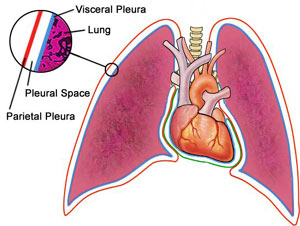
A pleural effusion is an excess accumulation of fluid in the pleural space around the lungs. Medical ImageThe pleura are thin membranes that enclose the lungs and line the inside of the chest cavity. The 'pleural space' describes the small space between the inner and outer layers of pleura, which normally contains a small volume of lubricating pleural fluid to allow the lungs to expand without friction. This fluid is constantly being formed through leakage of fluid from nearby capillaries and then re-absorbed by the body's lymphatic system. With a pleural effusion, some imbalance between production and reabsorption of pleural fluid leads to excess fluid building up in the pleural space. There are two major types of pleural effusion :
  • Transudative effusions, where the excess pleural fluid is low in protein; and
  • Exudative effusions, where the excess pleural fluid is high in protein.

Causes

Anything that causes an imbalance between production and reabsorption of pleural fluid can lead to development of a pleural effusion. Medical Image Transudative pleural effusions (those low in protein) usually form as a result of excess capillary fluid leakage into the pleural space. Common causes of transudative effusions include :
  • Congestive heart failure;
  • Nephrotic syndrome;
  • Cirrhosis of the liver;
  • Pulmonary embolism; and
  • Hypothyroidism.
Exudative effusions, which are high in protein, are often more serious than transudative effusions. They are formed as a result of inflammation of the pleura, which might happen for example in lung disease. Common causes of exudative effusions include :
  • Pneumonia;
  • Lung cancer, or other cancers;
  • Connective tissue diseases, including rheumatoid arthritis and systemic lupus erythematosus;
  • Pulmonary embolism;
  • Asbestosis;
  • Tuberculosis; and
  • Radiotherapy.
Source : virtualmedicalcentre.com

Pleural Effusion Care Plan

Nursing Diagnosis for Pleural Effusion

  1. Ineffective breathing pattern related to decreased lung expansion (accumulation of air / liquid), musculoskeletal disorders, pain / anxiety, the inflammatory process.
  2. Chest pain related to biologic factors (tissue trauma) and physical factors (chest tube installation)


Nursing Intervention for Pleural Effusion
  1. Ineffective breathing pattern related to decreased lung expansion (accumulation of air / liquid), musculoskeletal disorders, pain / anxiety, the inflammatory process.

    Marked by :
    Dyspnea, Tachypnoea, changes in depth of breathing, accessory muscle use, impaired development of the chest, cyanosis.

    Goal :
    The pattern of effective breath

    Expected results :
    • Indicate the normal breathing pattern / effective
    • Free cyanosis and signs of hypoxic symptoms

    Intervention :
    • Identify the etiology or trigger factor
    • Evaluation of respiratory function (rapid breathing, cyanosis, changes in vital signs)
    • Auscultation for breath sounds
    • Note the position of the chest and trachea development, review fremitus.
    • Maintain a comfortable position is usually elevated headboard
    • Give oxygen through a cannula / mask
    • If the chest tube is installed :
      • Check the vacuum controller, liquid limit
      • Observations of air bubbles bottle container
      • Hose clamps on the bottom of the drainage unit if a leak
      • Watch the ebb and flow of water reservoir
      • Note the character / amount of chest tube drainage.
  2. Chest pain related to biologic factors (tissue trauma) and physical factors (chest tube installation)

    Goal :
    Pain is reduced or lost

    Expected results :
    • The patient said the pain is reduced or can be controlled
    • Patients calm

    Intervention :
    • Assess for the presence of pain, the scale and intensity of pain
    • Teach the client about pain management and relaxation with distraction
    • Secure the chest tube to restrict movement and avoid irritation
    • Assess pain reduction measures
    • Provide analgesics as indicated
Source : http://nanda-nursing.blogspot.com/2011/03/nursing-diagnosis-and-nursing.html